
The free access to this article was made possible by support from readers like you. Please consider donating any amount to help defray the cost of our operation.
Reflections on Algorithmic Art Beyond Mathematical Structure
Sinan Kapçak
Abstract
This article explores the aesthetic and conceptual boundary between mathematical visualization and artistic algorithmic expression. Based on the author’s personal experience submitting a generative work to the Bridges Conference Exhibition—and its subsequent rejection—the essay reflects on the differing expectations between mathematically driven art and art that uses mathematics as a creative medium. It argues for a broader understanding of algorithmic art that embraces ambiguity, expression, and aesthetic intent, rather than solely mathematical clarity or structural recognition.
Key Words
algorithmic art; artistic intention; Bridges Conference; creative coding; generative art; mathematical structures and art
1. Introduction: creating with code
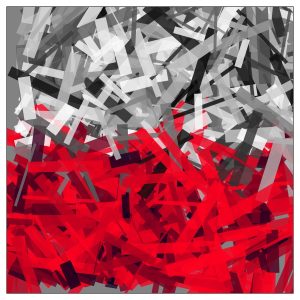
I recently submitted a piece of algorithmic art (Fig. 1) to the Bridges Conference Exhibition of Mathematical Art. It was not accepted. I do not take this as a definitive judgment on the quality of the piece, but the experience raised a question that remains with me: What exactly differentiates a mathematically rich image from a work of art created through mathematics? Where do intention, ambiguity, and aesthetic expression fit into this discussion?
As an applied mathematician and algorithmic artist, I often use mathematical concepts, such as dynamical systems, parametrized curves, transformations, or chaos, not to explain or visualize them but to shape visual forms that resonate on an aesthetic or emotional level.
This conceptual shift—where algorithms become tools of expression—can also be found in the works of early algorithmic artists such as Frieder Nake and Vera Molnár. Nake trained in mathematics and computer science, is recognized as one of the pioneers of generative art, using algorithms to explore visual structure while embracing aesthetic choices.[1] Molnár, though coming from a more traditional art background, used rule-based systems to create compositions that often subverted symmetry or broke formal regularities.[2] Both figures demonstrate how mathematically grounded systems can produce work that is not didactic or explanatory but poetic, suggestive, and open to interpretation. Casey Reas, co-creator of the Processing language, also emphasizes the use of code for visual form rather than structural illustration.[3]
2. Ambiguity and artistic intention
The Bridges Conference is one of the most respected venues for mathematical art, bringing together artists and mathematicians who explore the visualization of mathematical concepts through diverse media. Much of the work shown there adheres to certain expectations: mathematical clarity, recognizability of structure, and often pedagogical or conceptual depth. These are legitimate and valuable criteria—but they may not capture what makes some algorithmic works artistic rather than mathematical.
The piece I submitted to Bridges (Fig. 1), titled “Silent Chaos,” emphasized texture, motion, and abstract rhythm rather than clear mathematical structure. Its red-black layering was meant to evoke friction and energy, not symmetry or recognizable form. Its rejection, while understandable, prompted reflection: Perhaps my work does not belong in the category of mathematical art, as Bridges defines it. This realization was not disappointing; it was clarifying. It showed me that my creative goals lie more in the realm of generative or digital art, where ambiguity, emotional resonance, and visual experimentation are welcome.
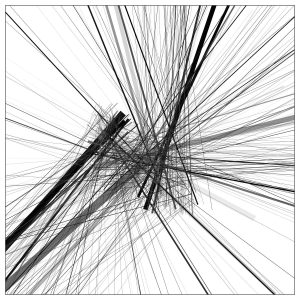
This is not an isolated example. Other works of mine, such as “Untitled Circles” (Fig. 2), composed of overlapping transparencies and fluid gradients, or “Tension Lines” (Fig. 3), a dense field of radiating lines, similarly avoid overt mathematical symbolism. While each is born from a set of coded rules, the resulting compositions are visual rather than bound by predictable mathematical patterns or explanations. They resist categorization. Their aim is not to demonstrate, but to exist—to be.
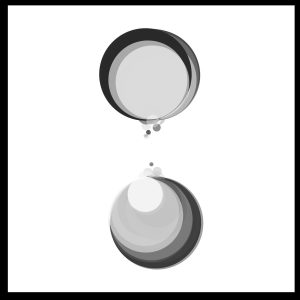
“Untitled Circles,” in particular, raises another dimension of this conversation. While it is based on simple iterative mathematical layering and controlled transparency, its final form is minimal, soft, and compositionally balanced. There is nothing visibly “mathematical” about it, and in that sense, it may appear too simple to be accepted as a mathematical artwork. But its simplicity is intentional—it is the product of an algorithmic process, just as “Silent Chaos” is. In this case, mathematics functions as a brush, not the subject.
3. Beyond visualization
Many artists who use mathematics are not trying to visualize it. They are composing with it—much like a musician might compose with scales and harmonics. Their work does not always present recognizable mathematical forms, but it is shaped by them. The current discourse often overlooks this form of practice: algorithmic art that uses mathematics as a method but not as a subject or visible structure. This distinction is important in understanding where such work fits within the broader landscape of mathematical and algorithmic art.
In reflecting on the difference between mathematical and algorithmic art, I propose a simple but important distinction:
– Type A: Mathematical visualization seeks to clarify and communicate specific structures.
– Type B: Artistic algorithmic expression seeks to explore form, feeling, and ambiguity through mathematically driven processes.
Both are valid. Both are meaningful. But they serve different purposes, speak different languages, and belong to different evaluative traditions. Recognizing this distinction can help artists, curators, and audiences better understand what they’re seeing—and what the artist is aiming for.
4. Conclusion
The rejection of my piece from a mathematical art exhibition became an unexpected opportunity for insight. It underscored the importance of recognizing the different intentions that underlie visual work created through mathematics. Not all algorithmic work is meant to reveal structure—some of it aims to stir emotion, provoke ambiguity, or simply exist as a visual poem shaped by code. In such works, mathematics is present—but it is not the message. It is the medium.
Sinan Kapçak
s.kapcak@tue.nl
Sinan Kapçak is a university lecturer in mathematics at Eindhoven University of Technology, based in the Netherlands. His research background is in discrete dynamical systems, and alongside his academic work he practices algorithmic art, exploring its expressive and aesthetic dimensions.
Published on January 21, 2026.
Cite this article: Sinan Kapçak, “Reflections on Algorithmic Art Beyond Mathematical Structure,” Contemporary Aesthetics, Volume 24 (2026), accessed date.
DOI: https://doi.org/10.62729/6a46857396e0b

Endnotes
[1] Frieder Nake, “There Should Be No Computer Art,” in Computers and Art, edited by Jasia Reichardt (Praeger, 1971).
[2] Vera Molnár, “Toward Aesthetic Guidelines for Paintings with the Aid of a Computer,” Leonardo 8, no. 3 (1975): 185-189.
[3] Casey Reas, Form+Code in Design, Art, and Architecture (Princeton Architectural Press, 2010).